When black metal was spreading across Europe in the mid-1990s, Norway dominated the headlines. Yet in Belgrade, amid political turmoil and cultural isolation, a group of young musicians was forging their own voice of defiance. May Result in Blood (later May Result), founded on the ominous date of 6 June 1995, remains one of Serbia’s most intriguing but overlooked acts – a band that merged the cold ferocity of the second wave with the imagery and rhythms of the profound feeling of Death & the mysticism of Slavic paganism.
“It is little known that the name Stone to Flesh was one of the names for the band originally proposed by Rastko … We all agreed and adopted Ilija’s proposal [May Result], even though we knew the name would only be grammatically complete as May Result in…, so for a time the longer version May Result in Blood was in circulation, but in the end we decided that the choice would be the shorter version May Result …”, says Kozeljnik in a special interview for SMP.
Though their name rarely surfaces outside collectors’ circles today, May Result’s intense career tells an important part of the story of an often-forgotten corner of the black metal underground, especially when it comes to the Balkans.
The original lineup – guitarist Kozeljnik (Marko Jerković), drummer Ilija, guitarist Rastko, bassist Vladan, and vocalist Srđan – played their first show in December 1995 in Smederevo. What began as a raw attempt to emulate the ferocity of Bathory and early Mayhem soon evolved into something more atmospheric and conceived a deeper meaning. From the start, May Result placed an emphasis on Slavic themes, writing about pagan rituals, folklore, and blasphemous rebellion.
Central to the band’s vision was the creative mind of Kozeljnik, who would later become a key figure in the Serbian underground. He was the thread connecting the band with other notable Belgrade acts, especially The Stone.
May Result’s first major statement came with “Gorgeous Symphonies of Evil” (2000), an album that showed the band’s duality: aggressive black/death riffing layered with symphonic touches. It was raw, ambitious, and unmistakably Eastern European in spirit.
“Lightning, Sword of the Dark Sky is actually the original title of the band’s debut album, which was originally supposed to be released for the Italian label Seven Art Music in early 1998. In the summer of 1997, the band signed a contract, but due to financial difficulties that followed a few months later, the publisher first postponed the release, and then decided to stop working and terminate the contracts signed until then, so that at the beginning of 1999, our first album, to put it slang, remained on the street. I remember that we mostly communicated with Seven Arts Music at Rastok’s house, and only through phone calls. Those moments of anticipation and the way of communication were very interesting, where everyone from the band would come to Rastek and wait for us to talk with the publisher at the agreed time. I remember the general sadness and the first big disappointment when, after one such conversation, we were informed that the publisher was closing down and that we were left without a published album at that moment. In the meantime, in the period of ’97 and ’98, the band already had more than half of the material for the next album and as time went on, and the release of the first album was more and more under the carpet, we informally decided not to release it, but to dedicate ourselves to the next release, which had already gone in a different direction stylistically. However, at the end of ’99, a new offer followed from the Austrian publisher CCP Records, and the whole arrangement was initiated by the band’s manager at the time, Dejan Ilic, who presented the band with a two-album contract with the Austrians, where the first in a series is our debut album. By the way, we did and distributed a limited cassette version of the album under the original name before this offer, so CCP subsequently demanded that the name of the album be changed and the album was officially released in the summer of 2000 under the name Gorgeous Symphonies of Evil.”, states Kozeljnik.
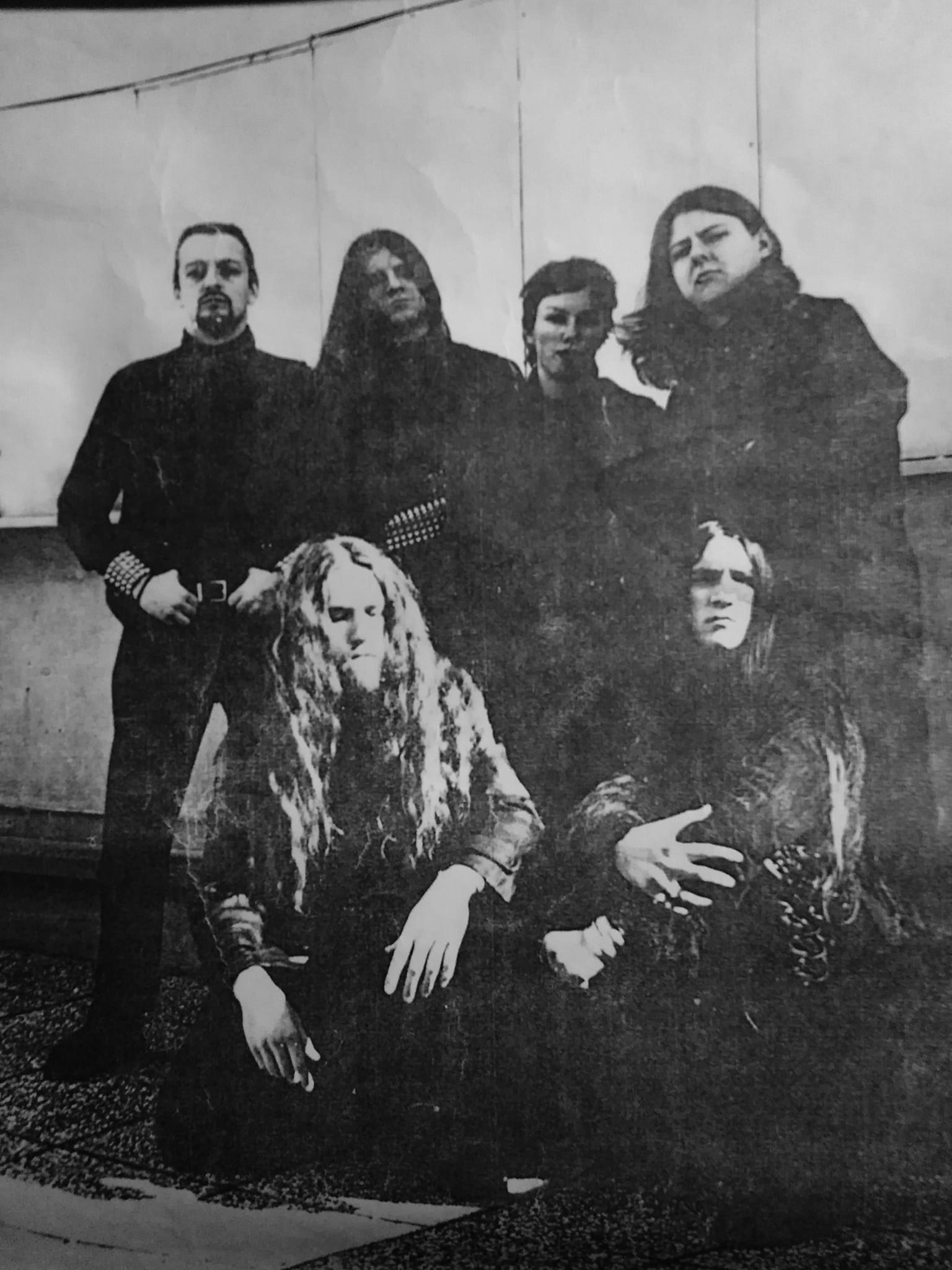
(Rare pre-Tmina era photo with old lineup. Photo by Zoran Kabic)
They followed quickly with “Tmina” (2001), which expanded on atmosphere and density, and later “Svetogrdje” (2004) – its title meaning “Blasphemy” in Serbian. Each record carried the hallmarks of the time: limited pressings, underground distribution, and cassette reissues that now circulate as collector’s items on Discogs.
Kozeljnik elaborates on the album: “Composing Tmina started even before the recording of the first album, and it was done in several stages. At the end of 1997 and during 1998, almost half of the album took shape, and Ilija, Dušan and moja malenkost took part in the composition, with the omnipresent supervision of Rastko, who further refined the ideas with his arrangement solutions. Unfortunately, what accompanied the band’s work then was dealing with the fact that the band did not have a complete line-up. Namely, the singer Srđan Perišić left the band, and a little later the keyboardist Predrag, so the work on the album was difficult and even interrupted at certain moments. At the end of ’98, keyboardist Iva Gojković joined the band, and a few months later Glad joined and took over the position of vocalist, so by the middle of 2000 we had almost a complete album finished. In October of the same year, we performed in Zagreb, where we premiered the whole new album, however, immediately after that concert, Iva left the band and the new keyboardist was replaced by Milan, who completely rearranged the keyboard parts and the band was ready for recording after a few months. We enter the studio totally inspired by the aggressive and cold tones, the furious and at times chaotic atmosphere that characterizes the album, and for the first time we show the apocalyptic side of the band, which was not the case before. I pick from memory the moments from the final rehearsals, just before recording, and I revive that feeling of inspiration with the energy that the songs exude while we perform them and somewhere right then we become aware of a new dimension that we are opening, directing the band to a darker side. I believe that the then newly arrived members, Glad and Milan, contributed to the birth of that atmosphere to a large extent, whose fresh creative blood gives an additional impulse and nuances the album with a multi-layered spectrum of darkness.”
By the late 2000s, they issued “Slava Smrti” (2008), perhaps their most polished effort, carrying the grandeur of their earlier work into a new decade. Yet despite the growing strength of the Serbian scene, May Result’s activity was increasingly sporadic. Side projects, lineup changes, and the pull of real-life obligations slowly eroded their momentum.
Lineups shifted constantly. Early members Vladan and Srđan departed, while vocal duties passed to Glad, who joined in 1999. Keyboard players (Stormbringer, Iva, later Urok) enriched the sound, but the constant turnover kept the band in flux. Still, every phase captured the Belgrade scene’s vitality, even if May Result never reached the notoriety of their northern peers (as most of the bands in the Balkans).
One of the defining features of May Result was their interconnectedness with other Serbian bands. Belgrade’s underground at the time was small, but fiercely creative. Musicians shared rehearsal spaces, recordings, and sometimes entire lineups. May Result were part of a network that included The Stone,Murder, Oculus, and Infest. Members often appeared on each other’s records, reinforcing a sense of scene solidarity. The cross-pollination of talent explains why the Serbian black metal sound of the late 1990s and early 2000s carries a recognizable identity: furious, yet enriched by pagan and Slavic undertones.
The band officially went on hold after 2010. Metal-Archives lists their status as “on hold,” though their catalog remains available through occasional reissues. Kozeljnik, Glad & Urok admit that their desire to revive the band exists, but nothing is set in stone and only time will tell if MAY RESULT will be reborn from the ashes.
Where are they now?
Kozeljnik (Marko Jerković) remains highly active. Beyond his main band The Stone, he launched projects such as Ophidian Coil and Kozeljnik, while also running Mizantropeon Records and Wrath Design, a visual design studio serving many metal bands. His artistic fingerprints are everywhere in the Serbian underground.
Glad, who took over as frontman, has continued working in Belgrade’s scene, including with the bands The Stone and Murder. He joined The Stone in 2006 as live vocalist and later, in 2018, became the lead vocalist in the band. So it may be safe to say that he is currently forging a lot in the fire, together with his band mate Kozeljnik.
Ilija, drummer from the beginning until 2006, left fewer public traces but is remembered for shaping May Result’s early aggression.
Rastko Marić, the original guitarist and later bassist, sadly passed away in 2020 (health failure). A loss felt deeply in the tight-knit Serbian community and the Balkan scene, in general.
Other contributors, such as Stormbringer, Urok, and Dušan, remain tied to regional projects – some with The Stone, others in local acts that rarely travel beyond the Balkans.
May Result never broke into the global black metal consciousness, but their importance lies elsewhere. They proved that Belgrade, even in times of hardship, could produce bands as fierce and imaginative as any other band from Scandinavia. Their story also illustrates the fate of many underground bands of the 90s: born of pure passion, yet hindered by unstable lineups and scarce resources. And yet, they left behind recordings that still whisper from the shelves of collectors and die-hard fans, preserving the memory of black metal’s first, tentative steps on the Balkans…
As our current scene grows and international recognition slowly increases, May Result deserves to be remembered as a testament to the strength and resilience of the Balkan black metal scene. Let there be fire!

Ancient flame, quietly burning through the shadows. Devoted to black metal and the Dark Arts since the late 90’s. https://linktr.ee/paulafazlich